

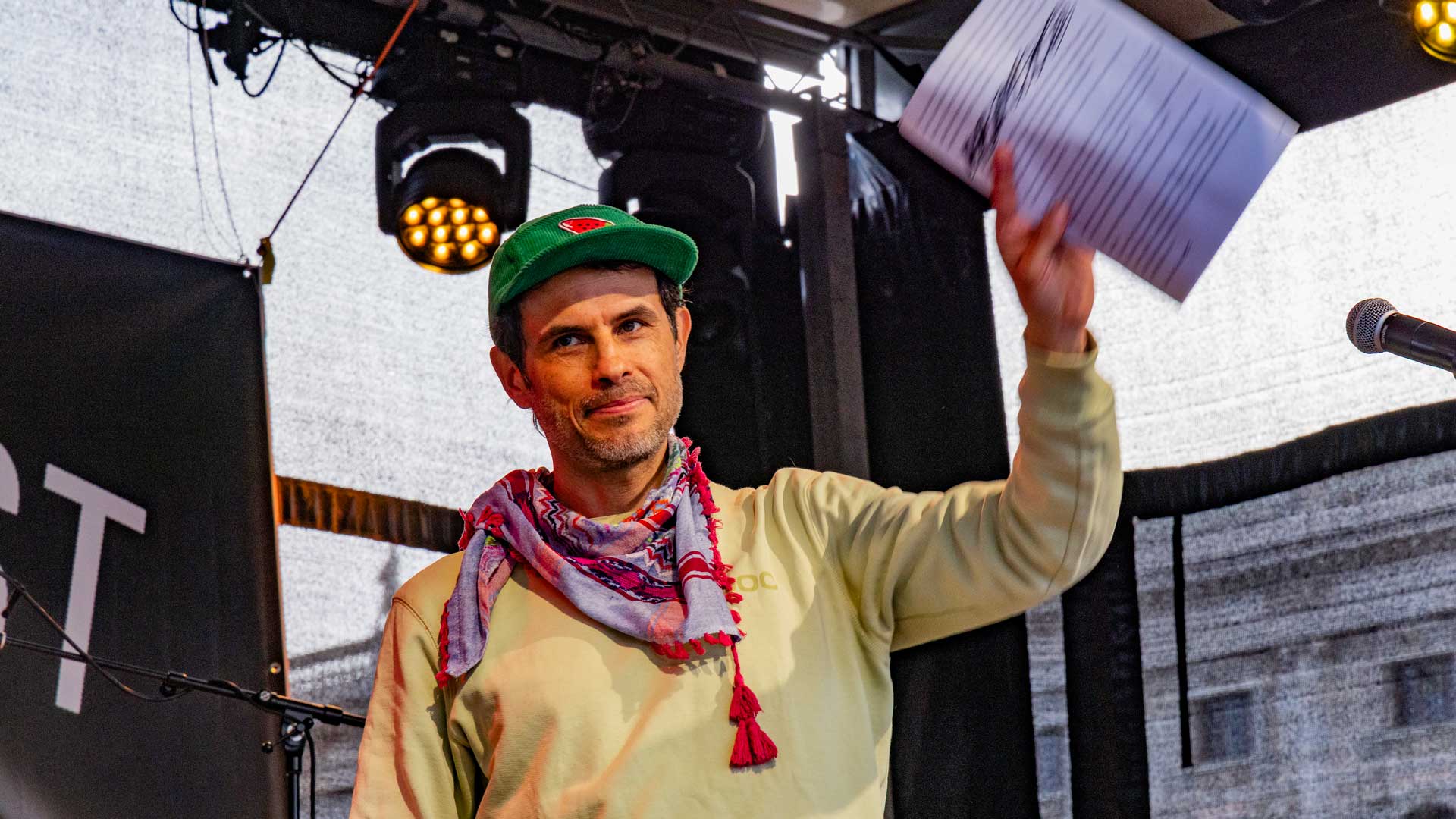
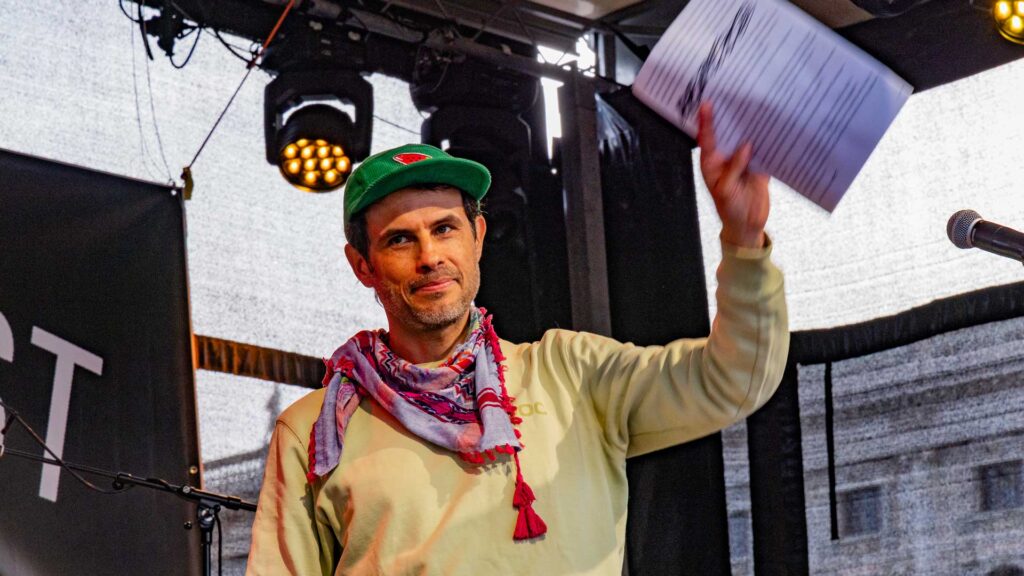
Song Protest “No Stage for Genocide” | May 15, 2026 Maria-Theresien-Platz, Vienna
Good evening, Vienna. We stand here today on Nakba Day at Maria-Theresien-Platz. A square named for an empress who ruled half of Europe through conquest, extraction, and the erasure of other people‘s stories. But tonight, this square belongs to us. To artists, to dreamers – to everyone who knows that the same colonial logic that carved up continents is now shaping our music stages, our airwaves, and our silences.
My name is Mauricio Lizarazo Prada. I was born in Bogotá, Colombia – a country intimately familiar with colonialism. The extraction of land, the extraction of labour, the extraction of culture. A place where we learned to dance amid chaos and violence, to laugh amid fear, and to create beauty on a landscape scarred by inequality.
For the last twenty-two years I‘ve worked as a tour manager and concert producer. I‘ve slept in vans, eaten catering I won’t describe, and learned how to fix a bass guitar with duct tape and prayer.
From 2013 to 2023, I toured the world with incredibly talented bands from Tel Aviv: A collective, Ninet Tayeb, Lola Marsh. I loved those musicians. They were my friends. We were really close.
But when I visited the Palestinian territories, I saw something that changed me forever.
The Checkpoint
Back in 2015, on a journey from Jaffa to Ramallah, I took a yellow taxi from East Jerusalem into the occupied West Bank. On that single journey, I witnessed two completely different worlds.
One: beach cafés, nightlife, a modern city living in oblivious abundance. The other: military checkpoints, towering concrete walls, and Palestinian children with eyes that had already learned too much about loss.
At one checkpoint, Israeli soldiers stopped us. Then they pulled a Palestinian child – no older than fourteen – out of the line and made him wait. For no apparent reason.
The soldiers spoke to me in Arabic. I switched to English. They asked for my passport. And when they saw my German document, suddenly they were almost polite to me. But to that child?
Disgust. They looked at him as if he were not human. They took him inside a shipping container behind military jeeps and tanks.
Another soldier shoved my passport back into my hands, yelling: “Yallah, yallah, get in, don‘t ask questions.” The taxi driver kept the engine running. I got back in the cab. They slammed the side door. And off we went.
To this day, I wonder: did that sweet child receive lawful protection? Did his parents know? Did he make it home? Does he still have a home?
That moment broke something in me. Because here‘s what I realised: the same logic of extraction that shaped Colombia – the logic that says some lives matter less, some stories can be erased, some cultures plundered – that same logic was standing right there in an Israeli army uniform.
And let me be very clear: opposing the brutal occupation is not antisemitic. I have known Jewish anti-Zionists – brave Israeli artists and activists – who have taught me that the most Jewish and just thing we can do is to stand up against the occupation and oppression of Palestinians. Because it is not good for anybody. Not for Israelis, trapped in a cage of fear and endless war. And certainly not for Palestinians, living the daily brutal reality of that cage.
The Music Industry‘s Double Standard
Now let me put on my music-industry hat for a moment. Because I love music, but I also know how the industry works.
I studied Music Business at New York University – right at the epicentre of the global entertainment machine, where the myths, structures and mechanisms of modern cultural production are both made and perpetuated. And what I witnessed there was a system built on extraction: culture becoming commodity, innovation monetised, success tied to privilege. The same logic that exploits land and labour also shapes the cultural industries we inhabit.
I learned about agencies like United Talent Agency – UTA, one of the biggest talent agencies in the world. And here‘s what I observed: when an artist speaks out for Palestinian human rights, UTA drops them. Susan Sarandon, Bob Vylan – their careers were damaged, not for hate speech, but for criticizing the Israeli government‘s policies.
That is the music industry‘s double standard – rooted in colonial logics of extraction: who gets to speak, who gets silenced, whose stories are amplified, whose are erased.
But here is the question we rarely ask: Who runs Eurovision?
Not a private talent agency. The European Broadcasting Union – the EBU. A union of public service media from across Europe. Funded by taxpayer money. Mandated to serve the public good. And yet, the EBU acts exactly like a commercial agency when it comes to Israel.
TheEBU‘sHypocrisy
Let me draw you a parallel. When Russia invaded Ukraine in 2022, the EBU banned Russia from Eurovision within days. The message was clear: you cannot commit war crimes and then come sing on our stage. When the International Criminal Court issued arrest warrants for Vladimir Putin, the EBU applauded its own decision.
Now ask yourself: what is different about Israel?
In January 2024, the International Court of Justice already ruled that the claim that Israel is committing genocide in Gaza was “plausible”.
Then, in September 2025, the UN Independent International Commission of Inquiry went further, concluding that Israel is responsible for the commission of genocide in Gaza.
In April 2026, UN experts confirmed that Israel has committed the crime against humanity of “extermination” in Gaza – including by killing civilians sheltering in schools.
More than 71,000 Palestinians have been killed – the majority women and children. UNESCO has verified damage to 157 cultural heritage sites in Gaza – 14 religious sites, 122 historically significant buildings, 9 monuments and 8 archaeological sites. More than 316 archaeological sites have been fully or partially destroyed. The Palestinian Minister of Culture has stated that the situation constitutes a systematic cultural genocide.
And the EBU? Silence. No ban. No suspension. No statement.
Why? Because the EBU is afraid. Afraid of the same lobbying networks. Afraid of the same political pressure that makes UTA drop an artist for a single pro-Palestine post. Afraid of losing funding from governments that shield Israel from accountability.
So here is my constructive criticism: the EBU could be a force for decolonization, for narrative sovereignty, for building stages where all stories are told. Instead, it has become a mirror of the colonial institution it was meant to transcend.
So, dear EBU: you cannot claim to stand for human rights and diversity through the power of music while giving a stage to a state that is systematically starving and bombing tens of thousands of civilians. You cannot ban Russia for one war and welcome another war with open arms. That is not principle. That is hypocrisy.
And it gets worse. While the EBU polices what artists say backstage, the Israeli broadcaster KAN has openly admitted to using Eurovision as a propaganda tool – and just this week was formally warned by the EBU for urging viewers to “vote 10 times for Israel”. The EBU‘s only response so far has been a wrist-slap.
Five countries have already boycotted this year‘s contest: Spain, Ireland, the Netherlands, Slovenia and Iceland. More than 1,100 artists have signed the “No Music For Genocide” letter – including Peter Gabriel, Brian Eno, Massive Attack, Kneecap and Paloma Faith. This weekend, thousands of demonstrators protested across Vienna, because even the authorities know: this is not just a song contest anymore. It is a political battleground. And the EBU has chosen the side of the oppressor.
The Erasure of Palestinian Music
Here is what the EBU and the mainstream media won‘t tell you: while they broadcast Israeli pop stars across Europe, Palestinian music and culture is being systematically erased.
This is not accidental. Cultural genocide is a deliberate strategy. It operates through the weaponization of memory, the destruction of heritage, and the systematic devaluation of a people‘s knowledge systems – what scholars call “slow erasure”: the layered, structural process through which settler-colonial regimes eliminate Indigenous identity, agency, and ways of knowing.
Music schools in Gaza have been bombed. Recording studios are rubble. The Edward Said National Conservatory of Music in Gaza – a cultural lifeline – has suffered extensive damage. A grand piano has gone missing.
But here is the beautiful, joyful, world-shaking truth: still, musicians play.
Hip-hop artists in Gaza, rapping their trauma and their hope. Electronic producers in Ramallah, weaving resistance into beats. Oud players in refugee camps, summoning centuries of heritage through their strings. Their music is a form of resistance – of Sumud, the Palestinian word for steadfastness. It‘s epistemic justice in action: the refusal to let a people‘s knowledge system be erased.
They don‘t have a PR team. They don‘t have a Eurovision stage. They have their voices and their instruments.
Tonight, we give them a stage. Right here.
A Decolonial Stage
While the EBU polishes its glitter ball a few kilometres away at the Wiener Stadthalle, we are here – in the heart of Vienna. Palestinian artists, international musicians, activists from across the globe. We are not here to hate. We are here to create – and to re-create. To sing. To dance. To remember. And to build a future where art serves life – not death, not oppression, not occupation.
This is a decolonial act. Because decolonization is not just about tearing down. It is about building up. It is about creating space for what the brilliant thinkers call “pluriversal horizons” – a world where many worlds fit, where equally valuable ways of knowing coexist, where Palestinian music stands alongside Ukrainian, alongside Colombian, alongside every voice that has been silenced.
This is our stage. A stage for justice. A microphone for the silenced. This is what happens when we move from critique to praxis – when we stop complaining about the system and start building the alternative.
The Invitation
So let‘s continue singing. Songs of hope. Songs that say “never again” for everyone. Donate to this cause – because this event is entirely volunteer-run, and every euro goes directly to building this stage for justice. Share this message. And when you go home tonight, do not look away.
I will leave you with something I wrote in a letter to my Israeli musician friends:
“Never Again is not a tribal slogan. Neither is From the River to the Sea. These are universal slogans. They mean that every human being deserves to live with dignity, freedom, and self-determination – from the Jordan River to the Mediterranean Sea, and everywhere in between.”
Remember: the most human thing we can do is to stand up against genocide and to oppose the brutal occupation. So tonight, we stand!
We stand for the Palestinian child at the checkpoint and all Palestinian children. We stand for the Gaza musicians who still play on top of the rubble.
We stand for music without genocide. A stage without propaganda.
And we stand for a decolonized future – where Gaza‘s music rises from the rubble, Palestinian justice frees us all, and in that freedom, every oppressed people finds its voice.
Thank you, Vienna!
Sources & References
International Court of Justice (2024)
Application of the Convention on the Prevention and Punishment of the Crime of Genocide in the Gaza Strip (SouthAfricav.Israel). Provisional ruling, 26 January 2024. The Court found it “plausible” that Israel‘s military operation in Gaza is genocidal in nature.
UN Independent International Commission of Inquiry (2025)
Report on the Occupied Palestinian Territory, including East Jerusalem, and Israel. Published 16 September 2025. The Commission found that “Israel is responsible for the commission of genocide in Gaza” with “specific intent to destroy the Palestinian group in Gaza.”
UN Experts (April 2026)
United Nations Independent International Commission of Inquiry report (presented June 2026). UN experts confirmed that Israel committed the crime against humanity of “extermination” by killing civilians sheltering in schools and religious sites in Gaza, part of a “concerted campaign to obliterate Palestinian life.”
Palestinian Ministry of Health / Palestinian Central Bureau of Statistics (PCBS)
By the end of December 2025, 70,942 Palestinians had been killed in Gaza, including 18,592 children and approximately 12,400 women, with around 11,000 missing.
Subsequent reporting indicated the death toll had surpassed 71,000. UNESCO (February 2026)
Impact on cultural heritage. As of 19 February 2026, UNESCO veriZied damage to 157 sites since 7 October 2023 – 14 religious sites, 122 buildings of historical and/or artistic interest, 9 monuments, 1 museum and 8 archaeological sites.
Palestinian Ministry of Tourism and Antiquities
Official data indicates that Israeli forces have fully or partially destroyed more than 316 archaeological sites and heritage buildings in the Gaza Strip, dating from the early Islamic, Mamluk, Ottoman and Byzantine periods.
Palestinian Minister of Culture (January 2026)
Minister of Culture Emad Hamdan stated that “the situation in Gaza constitutes a systematic cultural genocide, as the Israeli occupation seeks to erase Palestinian identity in all its forms.”
Edward Said National Conservatory of Music – Gaza branch
The school has suffered extensive damage. A grand piano has gone missing. Students are taught with the few surviving instruments.
United Talent Agency (UTA) dropping artists
Bob Vylan were dropped as clients by UTA following a performance at Glastonbury Festival. UTA also dropped actor Susan Sarandon after she spoke at a pro-Palestine rally in November 2023.
EBU warning to Israeli broadcaster KAN (May 2026)
On 8 May 2026, the EBU issued a formal warning letter to KAN after the Israeli artist released videos instructing viewers to “vote 10 times for Israel.”
Eurovision boycott 2026 – five countries
Spain, the Netherlands, Ireland, Iceland and Slovenia withdrew from the 2026 Eurovision Song Contest in protest against Israel‘s participation.
No Music For Genocide open letter (April 2026)
More than 1,100 artists and cultural workers signed an open letter calling for a boycott of Eurovision 2026 over Israel‘s inclusion, including Kneecap, Paloma Faith, Massive Attack, Brian Eno, Peter Gabriel and Macklemore.
Vienna protests (May 2026)
Thousands of people protested in Vienna against Israel‘s participation in Eurovision 2026, with event organizers estimating the crowd surpassed Zive thousand.
Amnesty International on EBU double standards (May 2026)
Amnesty International Secretary-General Agnès Callamard stated that “the failure of the EBU to suspend Israel from Eurovision, as it did with Russia, is an act of cowardice and an illustration of blatant double standards.”
© Mauricio Lizarazo Prada
https://www.instagram.com/maoliza
https://www.instagram.com/pachamama_culture/
www.pachamamaculture.com
www.musiccares.de
No Stage for Genocide, Palästina Solidarität Österreich, 2026. May be used freely with attribution.
