


By Sophie Gerber
In the historical study of National Socialism and the concentration camps, the fate of people from West Asia remains a blind spot to this day. While historical discourse was long dominated by debates surrounding political elites living in exile in Berlin, the individual lives and suffering of people from the region have remained almost entirely invisible in collective memory. One rare and historically significant exception is the Mauthausen concentration camp complex in Austria. Recent examinations of prisoner personnel cards and admission registers have documented the presence of at least four Palestinian men whose experiences challenge the boundaries of conventional categories of victims of Nazi persecution.
For decades, North African and Arab prisoners within the Nazi camp system were administratively subsumed under the European colonial powers and generally registered as “French” or “Spanish.” Mauthausen represents a remarkable exception in this regard: the camp administration explicitly recorded four prisoners from the British Mandate of Palestine under the nationality designation “Palestina” or “Palestine.”
The original documents preserved in the Arolsen Archives and the Mauthausen Memorial Archives provide a detailed picture of these four men:
- Mustafa Ahmed Batroukh (born in 1917 in Gaza; resident of Al-Majdal; prisoner number 137708)
- Abdula Abdul Hadi Daghili (born in 1920 in Hebron; prisoner number 137714)
- Ghalib Hilmi Said (born in 1912 in Jerusalem; resident of the Katamon neighbourhood; prisoner number 137725)
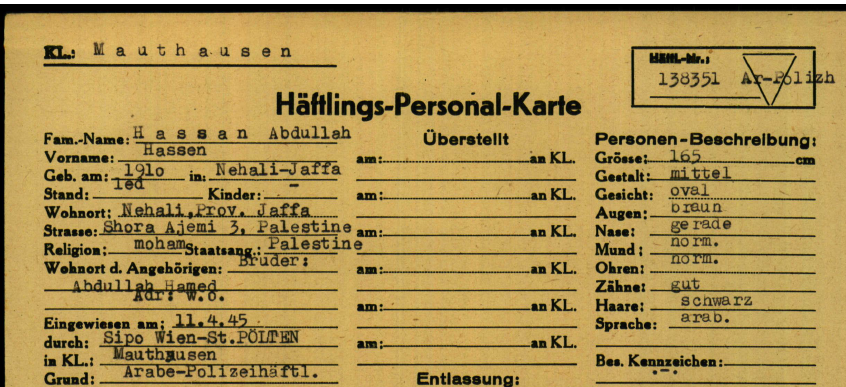
- Abdullah Hassen Hassan (born in 1910 in Jaffa; resident of the Ajami neighbourhood; prisoner number 138351)
The records reveal that the men came from widely dispersed locations across Palestine. Particularly noteworthy is the case of Ghalib Hilmi Said: in addition to Arabic, his personnel file documents fluency in both English and German, suggesting an advanced level of education or a previous period of residence abroad.
Contrary to earlier assumptions in the secondary literature, which broadly categorised these men as ordinary civilian labourers, the original personnel cards reveal an unequivocal classification. All four men were classified by the Gestapo as “Arabe-Polizeihäftlinge” (Arab police prisoners) and wore the red triangle, the unmistakable insignia used to identify political prisoners held in so-called protective custody within the Nazi concentration camp system.
The designation of Polizeihäftling (police prisoner) meant that the detainees were subject to the direct authority of the Security Police. Such classifications were frequently preceded by special proceedings involving suspicions of resistance activities, sabotage, breaches of employment contracts, or prohibited contact.
A shared institutional context of persecution is further supported by the dates of their admission and the authority responsible for their detention. Three of the men (Batroukh, Daghili and Said) were registered on the same day, 14 March 1945, with prisoner numbers issued in close succession; Abdullah Hassan followed on 11 April 1945. All four admissions were processed through the Vienna Security Police, St. Pölten branch office.
This suggests that the men were arrested in the spring of 1945 as part of regional Gestapo operations in what was then known as the Reichsgau Niederdonau (Reich District of Lower Danube) and subsequently deported to the already desperately overcrowded main camp at Mauthausen.
The discovery of these records raises fundamental questions that are now the subject of ongoing historical research:
1. The journey to Europe: How did these four men arrive in Austria before their arrest by the Gestapo in St. Pölten? Did they come to Europe as civilian migrant workers, as students, or as members of Allied military formations?
2. The precise grounds for their detention: What specific actions led the Gestapo to classify them as political police prisoners in the spring of 1945?
3. Their fate after liberation: Their arrival during the camp’s murderous final phase, characterised by catastrophic shortages, epidemics, and severe overcrowding caused by incoming evacuation transports, marks the last documented chapter of their imprisonment within the Nazi camp system.
Although death notices were entered alongside the names of certain prisoners in adjacent entries of the summary Mauthausen admission register, the names of Batroukh, Daghili, Said and Hassan are not recorded as deceased in the camp’s official death registers.
To reconstruct their subsequent fates, whether they died or survived liberation, three historical scenarios are currently being considered. These will be examined through targeted archival research in the next stages of the investigation:
- Scenario A (Death after liberation): The men survived the liberation of Mauthausen by the United States Army on 5 May 1945 but died in the weeks that followed as a result of the long-term consequences of their imprisonment, including typhus, tuberculosis, or extreme physical exhaustion, while receiving treatment in improvised Allied military hospitals.
- Scenario B (Registration as Displaced Persons): They survived their imprisonment and were subsequently registered by international relief organisations (UNRRA/IRO) in Displaced Persons camps in Austria, where they awaited onward travel.
- Scenario C (Repatriation through British military channels): As nationals of the British Mandate of Palestine, they fell under the jurisdiction of British military missions, which arranged their repatriation to West Asia through transit camps. Relevant post-war tracing records (Tracing Documents, T/D files) held by the Arolsen Archives, together with the records of the British Colonial Office in London, constitute the next crucial sources to be examined in this regard.
The microhistorical evidence from Mauthausen challenges the decades-long invisibility of Arab victims of Nazi persecution. The biographies of Mustafa Batroukh, Abdula Daghili, Ghalib Said and Abdullah Hassan demonstrate that Nazi terror transcended geographical and national boundaries.
A thorough scholarly reconstruction of their fates is not merely an academic undertaking but a fundamental obligation of historical integrity. It restores the victims’ individual identities and secures their rightful and lasting place within Europe’s collective culture of remembrance.
